|
Dear Chicago,
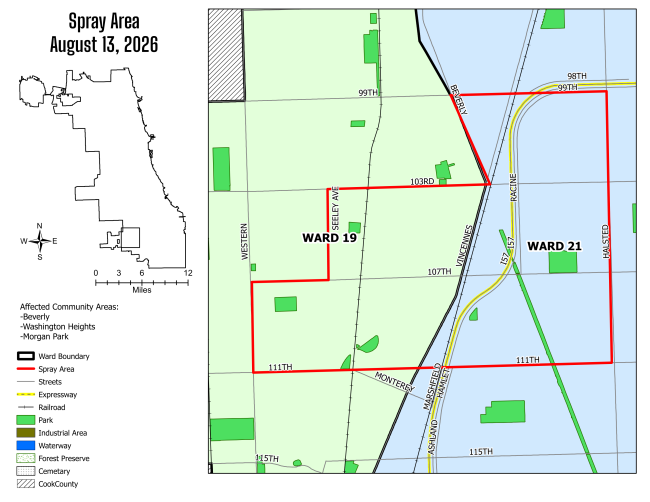
The Chicago Department of Public Health (CDPH) has detected an increased number of mosquitoes carrying West Nile virus in the eastern portion of the 19th Ward. On Thursday, August 13th, CDPH is scheduled to spray insecticide in the Beverly/Morgan Park communities bounded by 103rd Street, 111th Street, Western Avenue, Seeley Avenue, and Vincennes Avenue.
Weather permitting, the insecticide spraying will begin at dusk on Thursday, August 13th, and continue through the night until approximately 1:00 am Friday, August 14th. During this time, licensed mosquito abatement technicians will drive through the area outlined on the map below, dispensing an ultra-low-volume spray from trucks.
Each year, CDPH conducts a comprehensive mosquito surveillance, prevention, and control program to protect residents from West Nile virus and other mosquito-borne diseases. In addition to spraying, catch basins are treated in the spring to limit the number of mosquitoes that can carry the virus, and traps are placed throughout the city to collect mosquitoes to test for West Nile virus. By identifying locations with the most West Nile virus-positive mosquitoes, the city is able to efficiently target high-risk areas for the virus.
The material being used to control the adult mosquitoes, DeltaGard™, is approved for use by the U.S. Environmental Protection Agency and has been widely applied to control mosquitoes in outdoor residential and recreational areas. Licensed mosquito abatement technicians from Vector Disease Control International, a leader in the mosquito control industry, will apply the spray. Supervisors from the Chicago Department of Streets and Sanitation will guide the crews through our streets.
The spray is not harmful to people or pets and is routinely sprayed in residential areas across the nation. If residents are concerned about the spraying, they can choose to stay indoors and close their windows while it is underway. CDPH staff will be leaving door hangers in the treatment areas to notify residents that the spraying will occur.
CDPH reminds residents that the most effective way to prevent West Nile virus is to prevent mosquito bites.
- Use insect repellent that contains DEET, Picaridin, IR3535, or oil of lemon eucalyptus.
- Eliminate standing water. This means emptying water from flowerpots, gutters, pool covers, pet water dishes, and birdbaths regularly.
- Keep grass and weeds short to eliminate hiding places for adult mosquitoes.
- When outside between dusk and dawn, wear protective clothing. This includes long pants, long-sleeve shirts, socks, and shoes.
- Check that all screens, windows, and doors are tight-fitting and free of holes and tears.
- Check on neighbors regularly who may need additional assistance, including the elderly.
West Nile virus cannot be transmitted from person to person. Instead, it is transmitted strictly through mosquitoes. Most mosquitoes do not carry the virus. Additional information on the virus, including symptoms, how to protect against the virus, and recent mosquito testing trends, can be found on the CDPH WNV Surveillance Dashboard and the IDPH website. Residents are encouraged to contact CDPH at (312) 747-9884 with any questions or concerns.
Sincerely,
Matthew J. O'Shea
Alderman, 19th Ward
|